Magic Sugar
"Magic Sugar" explores the micro-history of life in former Soviet Khrushchev-style architecture and in Northeast China. From a child's perspective, the film retraces memories of life, childhood, illness, and the universe, presenting them as visual poetry and 3D mapping within existing Khrushchev-style buildings.
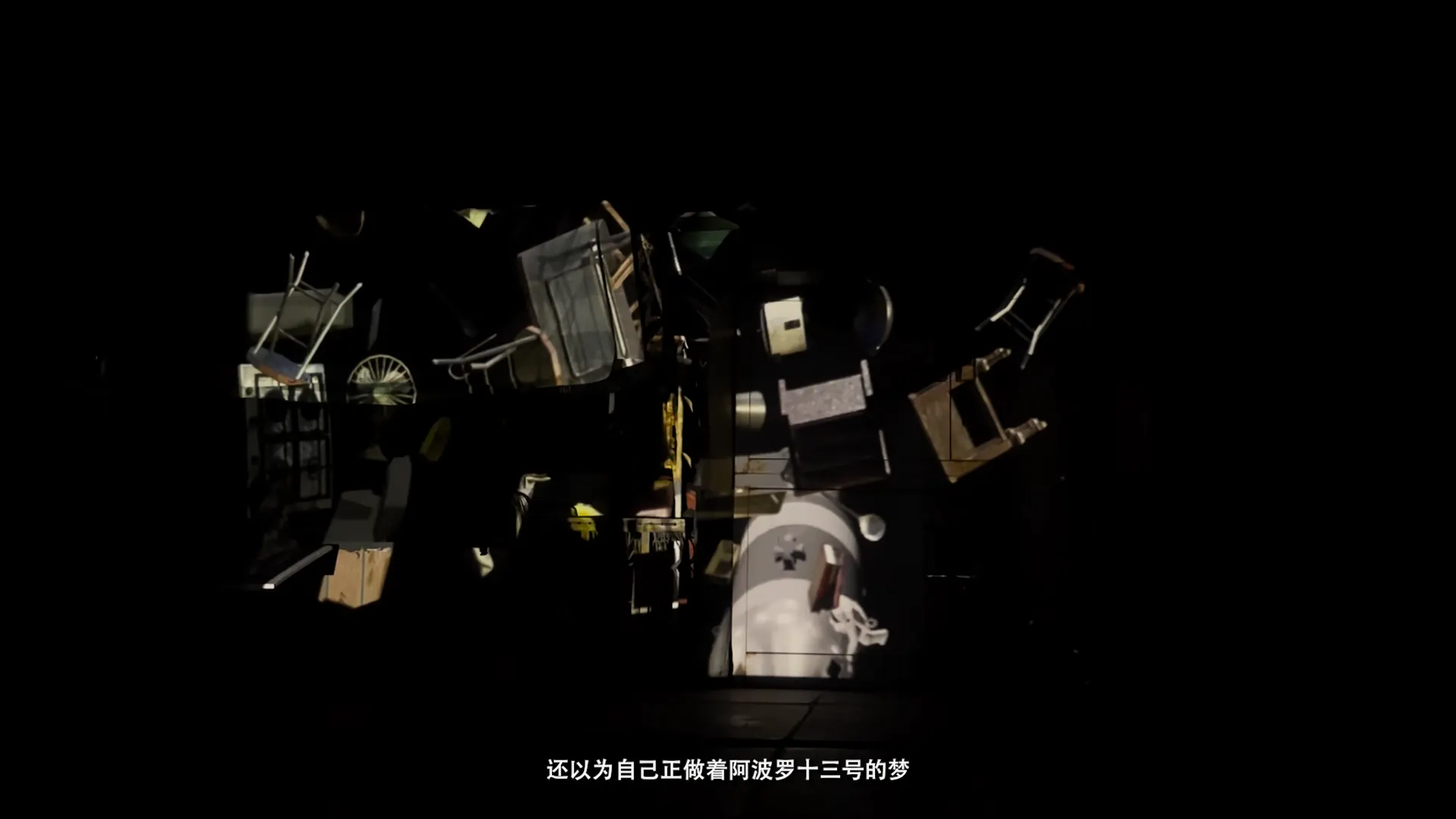
The film begins with a child swallowing a candy with hallucinogenic properties. It depicts that in a home in the year 2000, all the furniture and objects float up at midnight, as if in a state of weightlessness like in space. The snowflakes on the Toshiba TV screen flow out like tears from the screen. Amid the sound of a prescription being torn and the boiling of a traditional Chinese medicine pot, all the objects fall back from the air; on the prescription in front of them, there is still written that the traditional Chinese medicine needs to be boiled tomorrow.
The narrative interweaves fantasy and the pressure of reality, attempting to depict the discrete relationship between Khrushchev-style architecture and human existence through microscopic slices where illusion and reality overlap.
幻糖
《幻糖》是一件关于前苏联赫鲁晓夫式建筑与中国东北地区的微观生活史的创作,影片以一个孩童的视角回溯了关于生活、童年、疾病和宇宙的相关记忆,并以视觉诗和3D mapping的形式在现存的赫鲁晓夫式建筑中呈现。
影片中以孩童吞下一颗具有致幻作用的糖果开始,描绘了在2000年的家中,所有的家具和物件在午夜纷纷漂浮起来,如同在太空中一样失重,东芝电视机中的雪花点像是泪水一样从屏幕当中流淌出来,在处方笺的撕裂声和中药砂锅的沸腾声中,所有的物件从空中回落⸺面前的处方笺上仍写着明天需要熬的中药。
影片的叙述交织在幻象的虚妄和现实的压抑当中,试图从虚妄和现实交叠的微观切片中,描绘出关于赫鲁晓夫式建筑与人的生存之间的离散关系。